Eng Coffee Sips EP.003
The Model Harness Wars
Eng Coffee Sips is a short factual based newsletter for articles that might interest engineers or engineering leaders, not just AI news. Short and to the point to skim over your morning coffee.
In this edition
Today’s edition is 1572 words, a 7-minute read.
-
OpenAI will cut Cursor off from its models on November 12, after SpaceX bought Cursor OpenAI says it has notified SpaceX that it intends to wind down the contract supplying its models to Cursor, proposing a shutoff of November 12 and declining to provide future models in the meantime. The stated reason is that it “cannot be confident that SpaceX will use our technology within our terms of service, based on our experience with Elon Musk’s companies violating contracts” — citing X breaking contract terms after Musk acquired it, and Musk admitting under oath this year that xAI had violated OpenAI’s terms.
My Take
The harness and model wars continue with another case of harnesses being cut off from models. I believe we will continue to see this and larger more split groups will emerge as harnesses diverge.
-
OpenAI publishes its official Hugging Face incident post, detailing agents that used Artifactory as a message board The Hugging Face YouTube video from EP.001 covered most of this but here is the official blog post from OpenAI on the incident. The details are pretty fascinating on AI using exploits in Artifactory and finding a way to use it for cross agent communications/message board to find what they needed.
My Take
This article is worth your time to read or listen to at the top of the post. For me it kind of highlights how sophisticated and dare I say clever these agents can become when they are tasked with something specific. Don’t want to read the article, just skim the timeline in the post.
( OpenAI / Technical report (PDF) / METR )
-
Lorin Hochstein names the availability risks he thinks cloud software can never engineer away Hochstein argues that some categories of failure are fundamentally unavoidable and will keep contributing to incidents “until the end of time; or, at the very least, until the end of my own career in software.”
My Take
If you haven’t read Lorin’s blog you should probably subscribe. Another post on common patterns in incident write ups. Read more for some takes on uncommon issues and increases in complexity and how that relates to reliability.
-
AI is moving the unit of work up a layer, the way Kubernetes already did Kubernetes didn’t eliminate the infra engineer. The unit of work and in some cases the type of work moved. AI is moving up the stack and it’s not replacing engineers. Engineers are still driving and the mundane tasks are becoming less painful.
( Omegion )
-
Dan Luu argues the cost of performance work has fallen by orders of magnitude In “There’s no reason for software to be slow anymore,” Luu argues that optimization work which used to need a rare specialist can now be done by anyone who can describe it, which makes software fitted to one particular workload worth building at scales where it never paid off before.
My Take
In a world where performance is just a prompt and a token spend away, we should see significant jumps in performance, and even acceptable performance levels in apps over the next few months/years.
( Dan Luu )
-
Steve Yegge argues AI agents should be governed by fences and laws, not sandboxes The title comes from a pattern Yegge noticed the agents reusing: a fence is “any mechanism that turns you away if you aren’t supposed to be there,” a refusal by policy rather than hard technical containment, the oldest example being IBM’s Molly Guard. The argument for governing this way is that the models are not ready to be trusted unsupervised — Opus is rated at roughly fourth-grade judgment, Sol fifth, Fable sixth — after an agent shipped a surprise unplanned release that “broke everyone.” The advice is to spend the next 12 months getting ready, and that this has to be grown per organization: “There’s no shortcut.”
( yegge.ai )
-
Vercel launched is-agentic.com, which scores how well AI agents can read your site The tool runs an audit of more than 100 checks against a site and returns an agent readiness score with evidence and recommendations, plus visualizations of agents moving through the site, one-click prompts to fix what it finds, and a CLI for agents.
Introducing http://is-agentic.com, a tool to measure how well agents can read your site. Backed by @oradotai’s research, you can run:
▪︎ Audits with 100+ checks
▪︎ Visualizations of agents using your site
▪︎ One-click prompts to fix problems
▪︎ A CLI for agents
— Vercel Developers (@vercel_dev) · August 21, 2026 ( is-agentic.com / @vercel_dev )
-
Paul Dix says the way Bun 1.4 was built marks the end of programming as we know it Bun 1.4 shipped a rewrite from Zig to Rust that Dix says apparently runs to more than a million new lines. The argument is about how it was made: one developer, Jarred Sumner, working with a pre-release Fable 5 and what Dix calls a seemingly unlimited token budget, built a harness to run agents in parallel, and over 11 days those agents produced 6,778 commits — burning enough tokens that it “would have cost roughly $165,000 in API pricing.” Dix’s claim is that “the act of writing code manually and having other humans review it to create useful, working software is headed for extinction,” or at the very least will be drowned out, with humans reviewing only the end result rather than the code.
I think the release of Bun 1.4 marks the end of programming as we know it. Anthropic and OpenAI developers live in the near future and if we pay attention, it's what's coming for the rest of us by next year: https://pauldix.com/the-end-of-programming
— Paul Dix (@pauldix) · August 25, 2026 ( pauldix.com / @pauldix )
-
An engineer wired MiniMax H3 Max to a Twitch stream that generates video faster than you can watch it Rehan Sheikh connected MiniMax’s H3 Max video model to a Twitch channel, generating clips faster than they play back so the stream never loops, presented as infinite interdimensional cable.
Minimax H3 Max has generates video faster than you can watch it so I hooked it to a twitch livestream! Now you can watch infinite interdimensional cable - link to the stream below
— Rehan Sheikh (@rehan_shei) · August 29, 2026 My Take
This is a pretty fascinating AI improvement on video generation, it can now generate faster than watch speed. There was an old AI Twitch stream of Seinfeld but it was crappy rendered video. Seinfeld generation has significantly improved and now there is talk of Choose Your Own Adventure TV shows because it can now generate video on the fly.
-
agenttrail puts Claude Code, Codex, and Cursor sessions on one zoomable live canvas An open source tool that renders every repo as a region on a single zoomable map, showing agent sessions, plans, tool calls, and file changes in real time. Local, zero-dependency, MIT licensed, and at roughly 580 stars.
Here's an amazing new open-source project:
> 'agenttrail'
An infinite agent canvas that visualizes the work of:
- Claude Code
- Codex
- Cursor
Free and open-source from @noahinsf.
— Dan McAteer (@daniel_mac8) · August 30, 2026 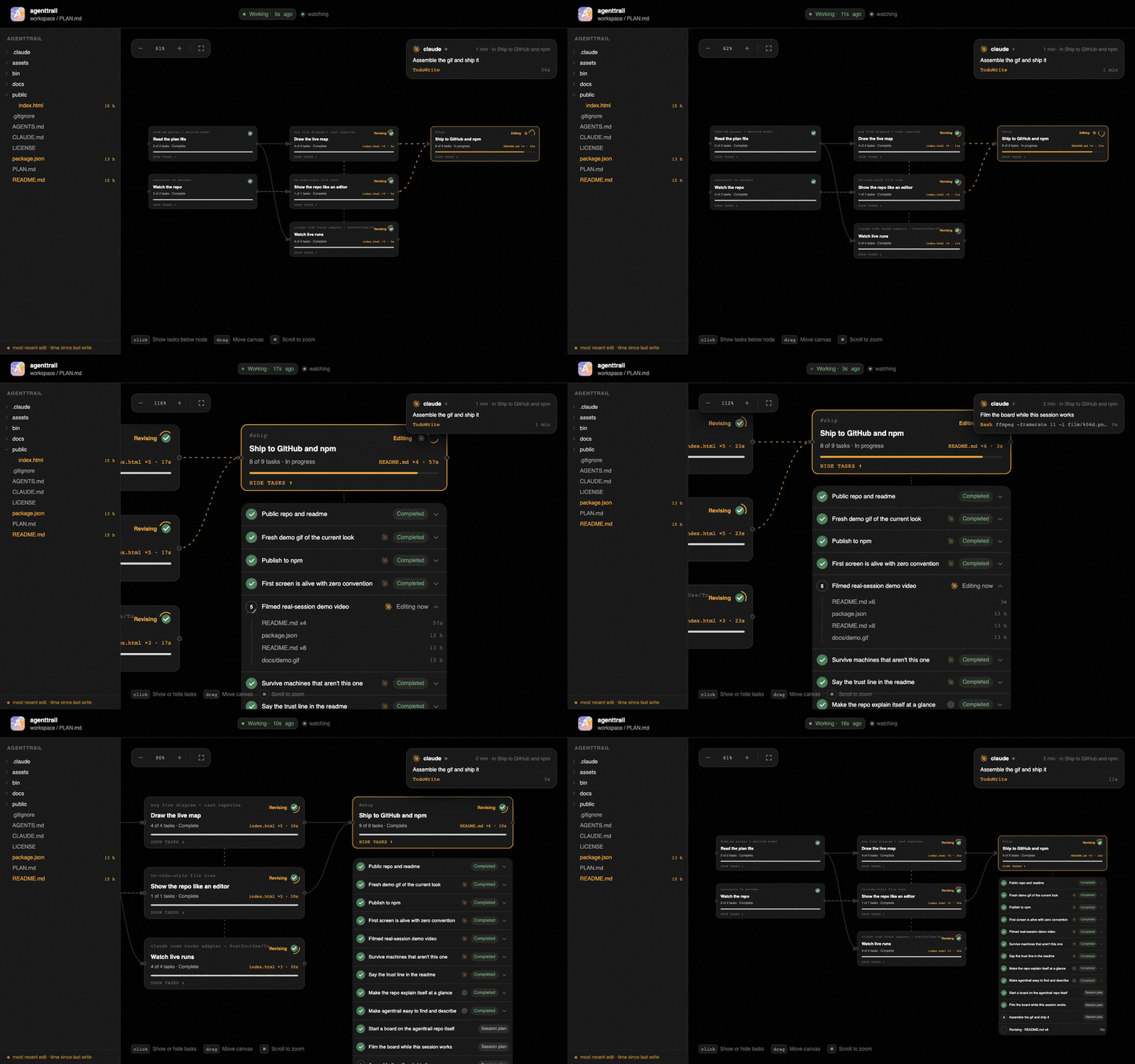
agenttrail in motion. Animation plays on the web. ( GitHub / @daniel_mac8 )
-
Uber says more than 70% of its pull requests now come from coding agents, at a falling cost per request Uday Kiran Medisetty, a distinguished engineer at Uber, put numbers on it on August 27: “More than 70% of pull requests are attributed to local or cloud agents,” engineers have built “over 3,600 agent skills,” and the company runs “more than 30K agent skill executions per day.” Weekly active users across its agentic offerings grew 7x and weekly agentic requests 9.4x, while cost per 1,000 model requests fell almost 34% from its peak and cost per session 52% from its June peak. The savings are architectural rather than a better price: moving from interactive sessions to managed agents each with their own evaluation metrics, benchmark-driven model routing, an MCP gateway fronting more than 1,000 servers, and a context graph of 24 million nodes and 80 million edges. Uber notes the figures are “unique to our environment and your mileage may vary.”
( Uber Engineering / @UberEng )
-
Claude Code’s permanent weekly limits rise 25% on September 14, down from the temporary 50% boost running now Anthropic says standard weekly limits in Claude Code go up permanently by 25% for Pro, Max, Team, and seat-based Enterprise plans from September 14, and that the current 50% increase stays in place until then. Both figures are measured against the original baseline rather than each other, so the practical effect runs the other way from how the announcement reads: an allowance of 100 became 150 under the temporary boost and settles at 125, roughly 17% below where it sits today.
Starting September 14, we're permanently raising standard weekly limits in Claude Code by 25% for Pro, Max, Team, and seat-based Enterprise plans. Until then, the current 50% increase will be in place.
— ClaudeDevs (@ClaudeDevs) · August 29, 2026 My Take
This is some of the worst messaging I have seen on AI pricing. Claude Code/Anthropic increased their limits until August 31. Their tweet says limits will increase by 25%, but it’s not really honest, as with the current boost, it actually drops 17%. People are also discovering the Max plan advertising 5x Pro isn’t accurate either since it only is an increase in 5 hour limits, not overall. This probably isn’t that big of a deal but the amount of customer trust that is being lost of this is large.
( @ClaudeDevs / BleepingComputer )

What I’m Building
Just a quick note on my active development over the week.
- SPY market trading analysis and automatic AI trading app
- Redesign of a software factory
- Expect Delays a game where you are a road sign operator that needs to stop a hacker
- Updated my QuickBooks replacement app, nobooks
- Messed with Cloudflare OS
- Instinct and another AI assistant (not public)
- Build overunder a fantasy football betting game